Google told investors on October 28 that AI Mode has “lower monetization”, and it answered by putting more ads into AI Mode and AI Overviews. The next day Alphabet had the worst trading day in its history. If you work on AEO or GEO, the share price isn’t the part to watch. The part to watch is that Google now has a strong reason to sell the same space where your citations appear.
The short answer is that nobody has shown yet that these ads cost you citations or clicks, and Google hasn’t published the numbers that would settle it. When I searched 20 general questions from Canada on November 2, a third of the 18 AI Mode answers that loaded carried a sponsored result, and I found no ad inside any AI Overview. The available data still suggests that being cited is better than not being cited, for both organic and paid clicks. So I wouldn’t change course. I’d measure citations properly, stop treating SEO and paid as separate plans, and leave the AI opt-out alone unless I had a specific reason to use it.
Key takeaways
- Google has a new reason to sell the space where your citations appear. On its Q3 call it said AI Mode has “lower monetization” and responded by scaling ads in AI Mode and AI Overviews, including to Canada. arvindkumar.ca
- The stock drop is not evidence that AI Overviews caused a problem. Google named currency, Asia-Pacific retail advertisers and post-World Cup media spending as the main drivers of the search slowdown, with AI Mode as an added point. arvindkumar.ca
- Ads and citations already compete on the same answer, in product carousels, follow-up questions and the citation display. Nobody has shown that a nearby ad costs a citation clicks, so treat it as a question for your own numbers. arvindkumar.ca
- In a small Canadian test of 20 questions, a third of the 18 usable AI Mode answers carried a sponsored result, and I found no ad inside an AI Overview. It was one account on one afternoon, so it is a first look, not a study. arvindkumar.ca
- Being cited still looks worth it. In Seer Interactive’s data, a cited brand had higher click-through rates than an uncited one on both organic and paid clicks, though the data is correlation only and predates this ad expansion. arvindkumar.ca
- Don’t opt out of AI Overviews because of this news. In Cyrus Shepard’s small test, regular organic clicks fell as well, so treat the opt-out as something to test on one section of a site with a clear reason. arvindkumar.ca
- No single report shows the effect, so combine Search Console, GA4 and your own checks. Then get a baseline this month with a list of 20 buyer questions, checked monthly, before ads appear on most answers. arvindkumar.ca
- My prediction is a hybrid where the AI answer and the ad become one thing, because people who get their answer may never reach an ad beside it. That would put a paid option one line away from your citation. arvindkumar.ca
- Ad spend doesn’t look like an authority signal so far. SE Ranking found AI Mode ads didn’t make advertisers more likely to be cited, and I expect any effect to stay indirect, through brand searches and mentions. arvindkumar.ca
Summarised from this post, formatted for answer engines.
What did Google actually say about AI Mode and ads?
Google said strong growth in AI Mode queries weighed on Search revenue because AI Mode has “lower monetization”. That comes from chief business officer Philipp Schindler on the Q3 earnings call. As Search Engine Journal points out, he didn’t say lower than what, or by how much.
Four other things from that call and the announcement that followed matter for this discussion.
- Demand isn’t the problem. Sundar Pichai said query growth is the highest it has been in five years.
- Google sees the new queries as new inventory. Schindler said most AI Mode queries are incremental and many are upper-funnel, and he framed that as more chances to monetize over time.
- Ads are expanding now. Google is scaling ads in both AI Overviews and AI Mode to more users and queries.
- More countries are coming. Google’s announcement adds 10 countries, including Canada, Australia and India, with the UK, Brazil and Mexico planned for this quarter. In the US, multiturn ads will appear on follow-up questions.
Did AI Overviews cause the stock drop?
Not on the evidence so far, and I’d be careful with any post that says so. Alphabet fell almost 13% on October 29 and lost about $482 billion in value, Fortune reports. Search revenue grew 12% against the roughly 15% analysts expected, capital spending more than doubled and free cash flow turned negative.
On the search slowdown itself, Schindler named currency as the largest driver, followed by Asia-Pacific retail advertisers and media spending coming down after the World Cup. AI Mode was an added point. Bank of America called the shift to AI Overviews a small headwind this quarter, and a likely larger one outside the US, where ads in those summaries are only starting. That last detail is the one I’d keep an eye on if your audience isn’t American.
Why should a site owner care about Google’s ad revenue?
Because Google’s revenue pressure shapes what the answer page will look like. AEO and GEO mostly aim at research-stage questions, where a person compares options and hasn’t decided yet. That is the same upper-funnel traffic Schindler described as a monetization opportunity. Outside the US, ads in those answers are only starting. This is my reading of the incentive, not something Google has said about citations.
Where do ads and citations now compete?
They compete for attention on the same answer, and in three places you can already see it.
- Product carousels. Google confirmed it is experimenting with sponsored products alongside organic ones in AI Mode, and says sponsored listings are labelled. It also says click rates on sponsored and organic product items are already similar, based on its own US data from late August to early September.
- Follow-up questions. Multiturn ads give Google more turns of a conversation to place an ad in, and those are the turns where a person is narrowing down a choice.
- The citation display itself. Brodie Clark reported that the citation card on desktop AI Overviews has been disappearing on many searches. Google hasn’t confirmed a test, and Barry Schwartz couldn’t replicate it, so treat this one as a thing to watch.
None of this proves that a citation gets fewer clicks when an ad sits nearby. I looked for that data and didn’t find it. It is still a fair question to ask of your own numbers from now on.
What did I see when I tested this in Canada?
I saw ads in AI Mode on a third of the 18 answers that loaded, and I found none inside an AI Overview. On November 2 I wrote down 20 general questions, half research and half buying, across different industries, then searched them from Canada. Google stopped me with a CAPTCHA after 13, so I ran the last 7 later that afternoon. Treat this as a first look, not a finished study.
- AI Overviews. One appeared on all 20 questions, and I found no ad inside any of them. Sponsored results appeared on the page for 11 of the 20. On one of those I didn’t capture where the ad sat, and it was gone when I repeated the search.
- AI Mode. A third of the 18 usable answers had a sponsored result after the answer text. That was 3 of the 10 research questions and 3 of the 8 buying questions. Semrush appeared on 4 of them, with Upwork and TD Insurance on one each. Two more AI Mode searches didn’t give a usable answer, so I left them out.
- Citations. I only started noting these on the last 7 questions. On “best home insurance in canada”, a TD Insurance ad sat under an answer citing sites such as Ratehub.ca and PolicyMe. On “best project management software”, a Semrush ad sat under an answer citing PCMag and G2. So an ad and citations can already share one answer.
| Question | Type | Sponsored results on the page | Ad in AI Mode |
|---|---|---|---|
| what is a crm | Research | Yes | No |
| how does seo work | Research | Yes | No |
| best crm for small business | Buying | Yes | Yes, Semrush |
| what is schema markup | Research | Yes | Yes, Semrush |
| best email marketing software | Buying | Yes | No |
| how to start an online store | Research | Yes | Yes, Semrush |
| best website builder | Buying | No | No |
| how to fix a leaky faucet | Research | No | No |
| best accounting software for small business | Buying | Yes | No |
| how to file taxes in canada | Research | No | No |
| best vpn | Buying | No | Not usable |
| how does solar power work | Research | No | No |
| best running shoes | Buying | No | Not usable |
| how to write a resume | Research | Yes | Yes, Upwork |
| best home insurance in canada | Buying | Yes | Yes, TD Insurance |
| how much does a new roof cost | Research | No | No |
| best travel credit card in canada | Buying | Yes | No |
| what is a heat pump | Research | No | No |
| best robot vacuum | Buying | No | No |
| best project management software | Buying | Yes | Yes, Semrush |
The limits are real. This was one signed-in browser on one afternoon, so the ads may reflect my account, and Semrush showing up on 4 answers makes me more cautious. Ads also change between searches. When I repeated the resume question minutes later, the Upwork ad was gone. My check read the page text, so it could miss an ad inside a collapsed AI Overview. I only noted citations on 7 questions, so this can’t tell you whether an ad costs a citation anything, and it says nothing about clicks. What it does show is that research questions can already carry an ad in AI Mode, at least on this account in Canada. I plan to repeat this monthly and record citations on all 20.
Is being cited still worth it if the answer has ads?
Yes, on the best data I can find, and it seems to help paid clicks too. Seer Interactive’s study of 53 brands, published in April, averaged click-through rates across informational queries for 2025.
- No AI Overview. 3.35% organic, 19.75% paid.
- AI Overview, brand cited. 2.07% organic, 15.74% paid.
- AI Overview, brand not cited. 0.94% organic, 11.19% paid.
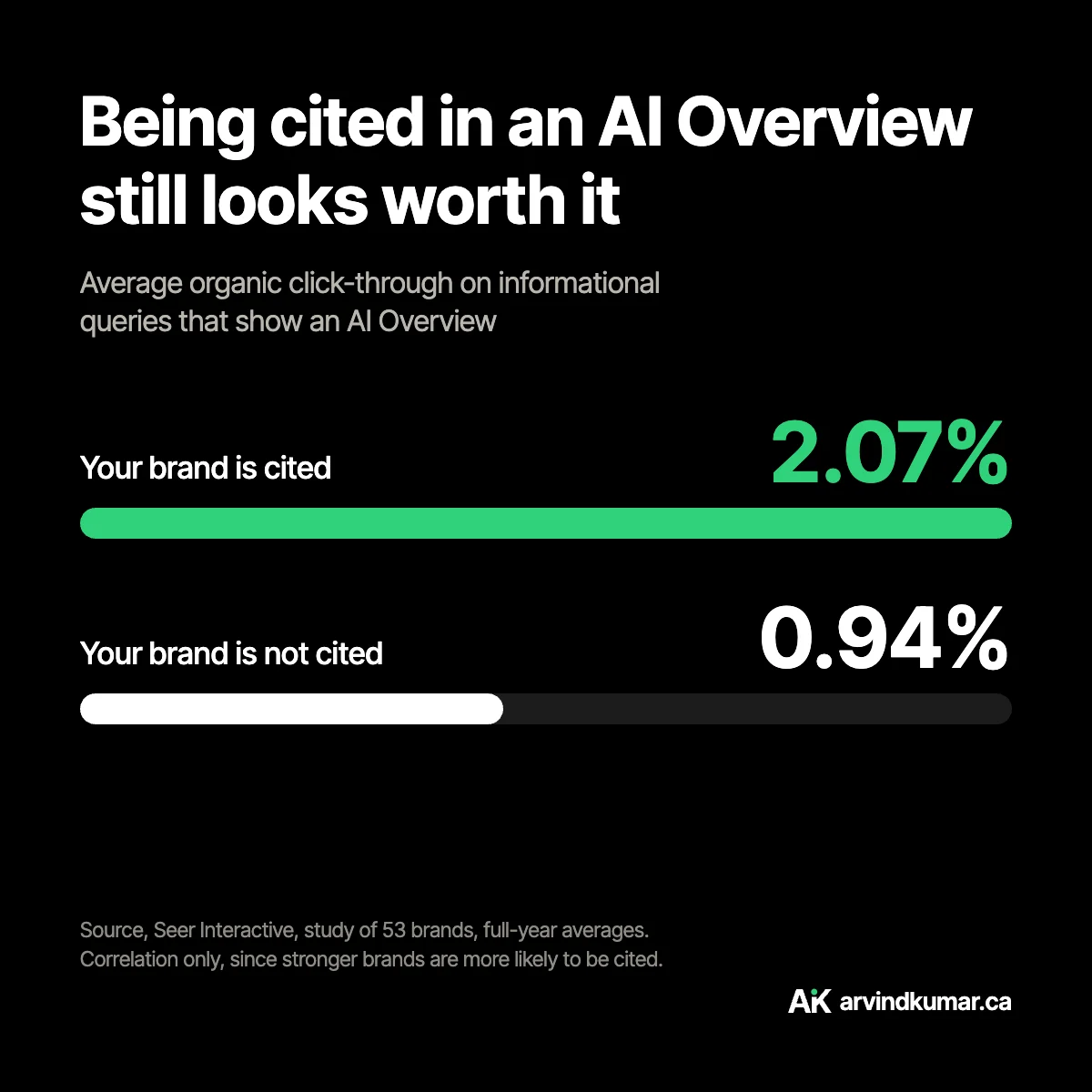
Two things stand out. Being cited doesn’t bring you back to where you were with no AI Overview. But the gap between cited and not cited shows up in organic and paid alike, which is why I no longer think of citations as only an SEO concern. The limits matter too. Seer calls this directional and correlation only, higher-authority brands are more likely to be cited, and the data predates this round of ad expansion.
Should you opt out of AI Overviews?
Not because of this news, no. Cyrus Shepard ran a small test on one site using Google’s opt-out control. AI impressions went to zero straight away, but regular organic clicks dropped during the test as well. He estimated AI impressions earned about a 0.9% click-through rate, which sounds like a good reason to leave until you see that the clicks around them fell too.
One site can’t settle this, and Shepard calls it a small case study. It is enough to make me treat the opt-out as something to test on a section of a site with a clear reason, not a protest against ads.
How do you measure this when Google hides the clicks?
You put together three partial views, because no single report shows it. Google gave a clicks-to-websites figure in Q2 and none in Q3, so you can’t lean on its public numbers either.
- Search Console. The generative AI report shows impressions by page, country, date and device. It has no clicks, no click-through rate and no queries, so use it to see which pages are appearing, not what they earn.
- GA4. Clicks from AI Overviews and AI Mode count as Organic Search, not under the AI Assistant channel. My guide to tracking AI assistant traffic in GA4 covers what you can and can’t separate.
- Your own checks. Nobody else will tell you whether an ad appeared beside your citation for the question you care about, so record it yourself, as in the steps below.
What should you do this month on a WordPress site?
Get a baseline now, before more ads arrive, then fix the pages that should be cited and aren’t. This is what I’d do on the sites I run.
- List 20 questions your buyers ask before they choose you, and keep them in a spreadsheet. You have it right if most are comparisons or how-to questions, not your brand name.
- Search each one once a month in AI Overviews and AI Mode, and note the date, whether you are cited, who else is cited and whether an ad appears. It worked if you can compare two months side by side. Results change between searches, so read it as a trend.
- Export the generative AI report from Search Console each month and keep it next to that sheet. It worked if you can see which pages gained or lost impressions.
- Confirm AI crawlers can read the pages you listed with this crawler check. It worked if the answer on each page shows up in the raw response, not only after JavaScript runs.
- Put the answer at the top of those pages. Make each H2 the question, and answer it in the first sentence. It worked if the opening sentence still makes sense when you read it alone.
- Clean up product data if you run a store. The same feed drives your free listings, so fix errors in Merchant Center before Black Friday. My post on UCP on WooCommerce lists what to check. It worked if the diagnostics page shows no account-level issues.
- Talk to whoever runs your ads. Search Engine Journal notes advertisers can’t target AI Mode directly. Broad match, AI Max, Shopping and Performance Max can qualify, while exact and phrase match may not. Share your question list and agree who covers what. It worked if you both know which questions you are paying for and which you hope to earn.
Will ads end up inside the AI answer itself?
I think they will, and that part is my prediction, not something Google has announced. An ad beside an answer has an obvious problem. If the AI Overview already answered the question, many people have no reason to look further, so they never reach the ad. Seer’s data points that way, though it is correlation only. On informational queries, paid click-through averaged 19.75% with no AI Overview, and 15.74% or 11.19% with one.
So I expect Google to build a hybrid, where the AI answer and the ad become one thing. You ask for a recommendation, and one of the options in the answer is paid. Most of the pieces already exist.
- The placement. Google has allowed ads within or next to AI Overviews in Canada since December, PPC Land reports. I still found none inside across my 20 searches, so this isn’t common yet, at least on my account.
- The layout. In May, Joe Kaziukenas shared an AI Mode answer with a sponsored coffee maker sitting between organic recommendations. Apart from a small Sponsored tag, it looked like the other results.
- The ad itself. Google’s Conversational Discovery ads use Gemini to build an ad from the person’s prompt and the brand’s own material, labelled as sponsored.
- The intent. Vidhya Srinivasan, Google’s VP and GM of Ads and Commerce, said “the best ads must be answers”.
If that happens, the fight changes. Today you are trying to get cited in an answer with an ad somewhere near it. In a hybrid, you could be cited one line away from a competitor who paid to be there, and a small label may be the only difference a reader notices. Google says ads don’t influence its AI answers, and that is the claim I’d watch closely. It is also why I’d plan SEO and paid together now.
I could be wrong about how far this goes. Google may hold back if people stop trusting the answers, because that trust is what keeps them searching there. My monthly check looks for an ad inside an AI Overview, so I’ll see it if it starts showing up on my questions.
Could ad spend become an authority signal for AI Overviews?
Not directly, on the evidence I can find, though I think ads could still shape who gets cited in indirect ways. This matters because if paying for ads earned citations, AEO would turn into a budget line.
- Ads don’t appear to buy citations. SE Ranking checked 50,032 US commercial keywords in AI Mode on June 30, and text ads showed on 29.45% of them, not far from the third I saw in my smaller test. Only 11.53% of advertiser domains were cited for the keywords they advertised on, and advertising didn’t make them more likely to be cited than similar sites that weren’t advertising.
- Ad spend is a weak signal next to brand. Ahrefs’ study of 75,000 brands found ad cost had a weak correlation with AI Overview mentions, about 0.2. Branded web mentions were roughly three times stronger. That study is from 2025 and shows correlation, not cause.
So I don’t expect Google to treat ad spend as a ranking benchmark. It would be a big risk to the trust its answers depend on, and Google says ads don’t influence them. My prediction is more indirect. Ads can get a brand searched and talked about, and those are the signals that line up with AI visibility. Nobody has shown that chain yet, so treat it as a theory.
The bigger shift may be in how it looks to the reader. In a hybrid answer, a paid option sitting beside a cited source could feel like authority even if it never touched the ranking system. That’s why I’d keep earning citations and track the ads beside them, rather than expect one to buy the other. I’d also revisit this as formats change, because SE Ranking’s data covers today’s text ads, not the hybrid I expect.
I’ll be watching two things. One is whether Google says how much of the gap ads have closed by next quarter, and the other is whether anyone publishes citation click data from pages that carry ads. Until then, get your baseline this month, while, at least in my test, ads are on only some answers. Once they are on most of them, you won’t be able to measure what changed.